What is RFID and where can it be used?
An introduction to using RFID. APX has delivered more than 120 RFID solutions since 2007.
Technology for efficient tracking and control
RFID is changing how industries identify objects, trace their movement and automate processes. Suitable systems can read hundreds of unique tags per second without a direct line of sight, making high-volume identification faster and more precise.
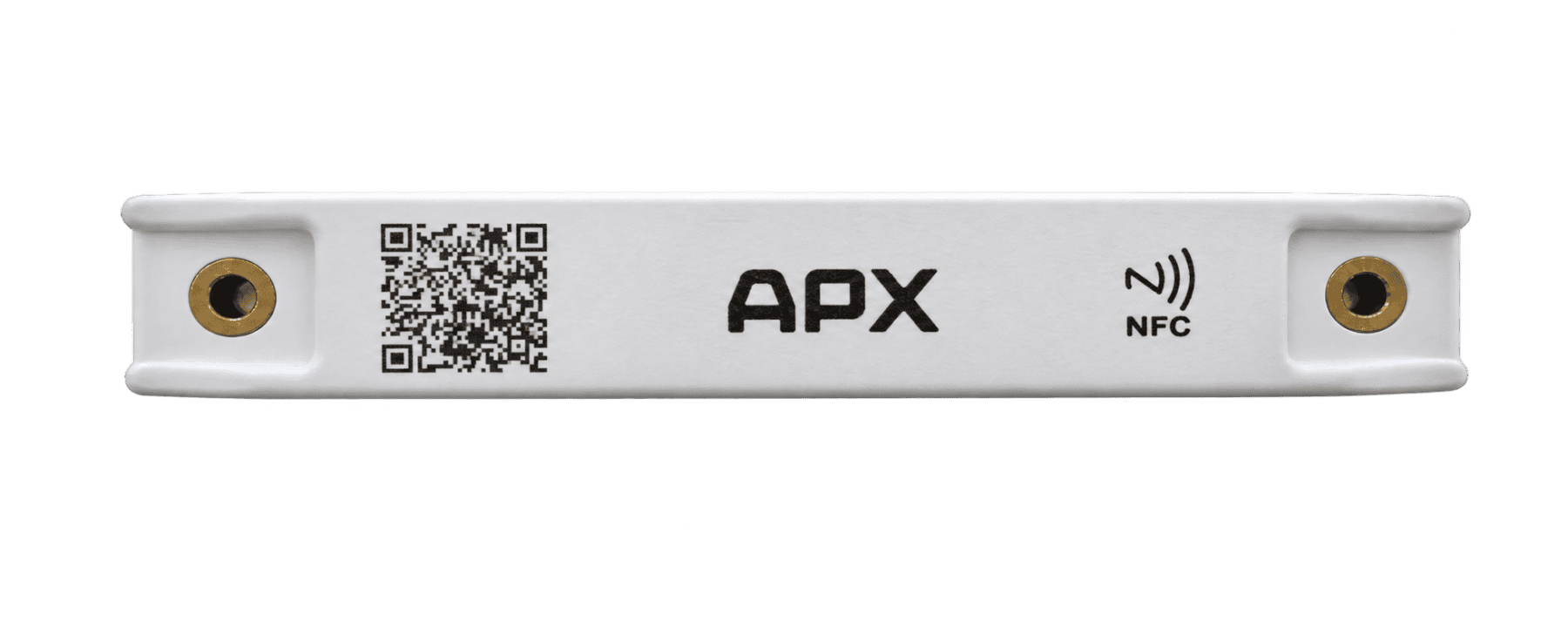
How does RFID work? An RFID tag can take the form of a small device or card. Tags can be passive or active:
- Passive RFID tags draw energy from the reader and respond with their unique identifier.
- Active RFID tagshave their own power supply and can transmit over longer distances. A vehicle toll tag is one example.
Different RFID technologies suit different applications.
- NFC (Near Field Communication): A short read range suitable for access control and payments.
- UHF (Ultra High Frequency): Read ranges of up to 40–50 metres for logistics and production applications.
Quick, accurate visibility
- Scan hundreds of unique objects per second.
- No direct line of sight is required. RFID can read through materials such as plastic and cardboard.
- High precision. Unique identifiers support item-level traceability.
- Connect to a database to link each RFID identifier with the relevant information.
New applications for identification technology
✔ Production: Automate production lines with RFID read points. Start, stop and control processes in real time using RFID identification.
✔ Logistics: Speed up goods receipt, stock counts and the movement of goods. RFID is often combined with GPS to locate stock stored outdoors.
✔ Retail: Count stock in seconds with accuracy approaching 100%. RFID can also support automatic checkout.
✔ Hospitals and healthcare: Track medical equipment and patient records to improve safety and efficiency.
✔ Museums: Monitor valuable objects by automatically recording movements between rooms and floors.
Interested in using RFID in your business? Contact us for an initial conversation, or meet us at the annual RFID conference, RFID Journal LIVE!
How UHF technology works and where it is used
UHF stands for Ultra High Frequency . UHF RFID uses radio waves to identify and track objects wirelessly. Warehouses, shops, hospitals and transport operators use it to identify many items quickly without physical contact or a direct line of sight.
What is UHF RFID and how does it work?
RFID (radio-frequency identification) uses radio waves to identify objects automatically without contact. UHF refers to Ultra High Frequency, the band used by the RFID system, typically around 860–960 MHz. A UHF RFID reader can read a tag from several metres away using radio signals.
An RFID system generally has two main parts: RFID tags and an RFID reader with an antenna. Each tag contains a microchip and an antenna. The chip stores information about the object, such as a unique ID or product data. The antenna receives and transmits radio waves. The reader uses one or more antennas to transmit a signal and listen for responses from nearby tags.
How it works: The reader sends a signal in the UHF band. When a passive RFID tag comes within range, its antenna picks up energy from the signal. The chip uses this energy to return a response through a process called backscatter. The response contains the tag’s ID or stored data, which the reader receives and interprets. A reader can pick up many tags in a fraction of a second. While barcodes are normally scanned individually and must be visible, UHF RFID can identify dozens of tags together, including tags inside a box or behind other items.
Example: Imagine a carton full of products bearing UHF RFID tags. As it passes through an RFID portal at a warehouse entrance, the reader can register all the products in seconds. The system records the contents without anyone opening the carton or scanning each item individually.
The difference between passive and active RFID systems
RFID tags can be passive or activedepending on how they are powered and transmit signals:
- Passive RFID tags: Passive tags have no battery. They remain dormant until they enter a reader’s field, then use energy from its radio signal to respond. Without a battery, they can be small, often as thin as a label, inexpensive and long-lasting, with no battery to run down. Typical passive UHF read ranges vary from a few centimetres to several metres, depending on tag antenna size, reader power and the surroundings. Retail and logistics operations often use low-cost passive tags on individual products, parcels and pallets.
- Active RFID tags: Active tags have their own power supply, usually a small battery. They can transmit independently or strengthen the signal returned to the reader. Many have a range of tens of metres, while some specialist tags reach 100 metres or more. They may include temperature or motion sensors or have additional data storage. The battery makes them larger and more expensive. It needs replacing or recharging after a period of use, often several years. Active RFID is commonly used to track valuable assets such as containers, vehicles and equipment, or where longer range is needed.
There are also semi-passive (battery-assisted) RFID tagsthat use a battery to power their circuitry when they receive a reader signal, instead of sending continuous beacons. They can offer greater range than passive tags while conserving battery life. The simplest distinction is between battery-free passive tags and battery-powered active tags.
When should you use passive or active tags? Passive UHF tags suit high-volume applications such as retail stock, warehouse pallets or hospital wristbands. Active tags suit longer ranges or additional functions, for example identifying vehicles at a toll gate, monitoring a vaccine shipment with a temperature sensor or tracking valuable tools on a building site. Both types can be combined where needed.
Advantages of UHF RFID compared with other technologies
UHF RFID offers several advantages over conventional identification and tracking methods such as barcodes, magnetic stripes and manual registration.
- No line of sight required: While a barcode or QR code must be visible to a scanner, RFID readers can detect tags without a direct line of sight. A UHF RFID tag can be read through packaging, inside a box or behind another item if the radio signal reaches it. This saves time when items are tightly packed or out of view.
- Read several items at once: UHF RFID systems can read many tags at once. A pallet load can be registered as it passes through an RFID portal without scanning every carton or product. This can save considerable time in warehousing and logistics. Under favourable conditions, readers can register hundreds of tags per second. Barcodes are normally scanned one at a time.
- Speed and automation: RFID readings are fast and easy to automate. Fixed antennas at doors, gates or conveyors can register passing items without manual input, reducing missed scans and freeing up staff. A shop employee can count stock by walking through the premises with a handheld RFID reader in a fraction of the time required to scan each barcode.
- Data storage and updates: An RFID tag can store more information than a typical barcode. A barcode often encodes a number linked to a database, while a tag can store a production date, a batch number or a service record. Some tags can be updated wirelessly without replacement. In maintenance, for example, staff can record inspections directly on the equipment’s tag.
- Durability: RFID labels can be more resistant to dirt, wear and harsh environments than printed barcodes. A torn, dirty or faded barcode may become unreadable. An RFID tag can still be read if its chip and antenna are intact, even when hidden from view. Specialist tags are available for high temperatures, chemicals or damp conditions in which printed or handwritten markings could fail.
- Security and access: RFID at UHF and other frequencies can support secure access control. Some tags use encryption and are harder to copy than magnetic stripe cards. Building passes and toll tags can carry unique codes that the system validates, logging who passed through each access point.
- Comparison with other RFID technologies: UHF generally offers longer range and faster data transfer than low-frequency (LF) or high-frequency (HF/NFC) RFID. NFC, used for mobile payments and access cards, usually reads one tag at a distance of a few centimetres. UHF can read many tags from several metres away, making it useful in warehouses and logistics. HF/NFC offers advantages for applications such as payments but is less suited to bulk reading at a distance.
- Long-term cost savings: UHF RFID requires an initial investment in readers and tags. It can reduce costs over time by automating work, reducing losses, improving stock control and cutting excess inventory. Passive UHF tags often cost only a few Norwegian kroner or less in large quantities, making large-scale tagging practical.
In summary: UHF RFID provides fast, contactless identification without a direct line of sight. Its ability to register many items at once makes it valuable wherever conventional identification methods struggle to keep pace.
Applications across industries
UHF RFID is used in many sectors. Examples include logistics, retail, healthcare, manufacturing, transport and the applications below.
Logistics and warehouse management
- Goods receipt and dispatch: Warehouses and distribution centres use UHF RFID readers and portals to register incoming and outgoing goods automatically. As a pallet passes through a portal, the reader can capture all tags on its contents in seconds. Staff can receive goods quickly and accurately without scanning each package.
- Warehouse stock counts: Staff can count warehouse stock by walking the aisles with a handheld RFID reader. Fixed readers on shelves or ceilings can also help locate items. This gives a current view of stock and shows where a tagged item was last detected, reducing the time spent looking for it.
- Tracking across the value chain: From the factory to the shop, goods can be tracked at each milestone. UHF tags on containers and pallets can be logged at customs checkpoints and warehouse entrances. Logistics partners can share these records to find shipments, spot delays and monitor their supply chain.
Retail
- Retail stock counts: Retailers use UHF RFID to track goods on their shelves. Each garment or electronic item can carry a small tag. A shop employee can walk the floor with a handheld reader and count stock in minutes because the reader picks up nearby tags wirelessly. More frequent and accurate counts help prevent empty shelves and excess inventory.
- Automatic checkout and the customer experience: RFID enables fast self-service checkout. Instead of scanning individual barcodes, a checkout can read every tagged item in a trolley when the customer places it in a designated zone or passes through a portal. This can significantly shorten queues. Some concept stores use smart shelves that detect when goods are taken or returned, updating stock records or triggering information on a shelf display.
- Theft prevention: Many retailers fit security tags to clothing and other goods. When UHF tags are linked to a security system, readers at the exit can trigger an alarm if an unpaid item leaves the shop. A unique tag ID can also help establish exactly which item was taken and identify it if it is detected later.
- Customer engagement and product information: NFC is more common for this purpose, but UHF tags can also provide access to product information. For example, a sales assistant can scan a smart price tag to check availability or show a customer product details. Most smartphones read NFC, a form of HF RFID, rather than UHF. Future developments may give shoppers more ways to access in-store information.
Healthcare
- Patient identification: Hospitals can give each patient an RFID wristband containing an ID and, where appropriate, relevant health information. Nurses and doctors can scan the band to verify the patient’s identity before giving medicines or performing procedures. This reduces the risk of errors and provides quick access to records. UHF tags can be read from a short distance even if the wristband is out of view.
- Tracking equipment and medicines: Equipment such as syringe pumps, wheelchairs and monitors moves between hospital departments. Tagging it with UHF RFID lets staff look up where nearby equipment was last detected, for example when they need an infusion pump. This saves time, helps prevent loss and reduces unnecessary purchases. Medicines and blood bags can also carry RFID tags to track stock, monitor expiry dates and maintain traceability for recalls or transfusion checks.
- Tracking instruments and textiles: Surgical instruments can carry miniature RFID tags. After a procedure, scanning instruments and surgical textiles helps teams check that all items are accounted for and have been disposed of correctly. Hospital laundries can use HF or UHF tags to sort linen and uniforms, count wash cycles and identify where each item belongs.
Industry and manufacturing
- Production lines and manufacturing logistics: Manufacturers use UHF RFID to track work in progress as goods move through production. A part or product can be tagged at the start of the line. At each station, machines read the tag to determine the next operation. In vehicle production, for example, a chassis tag can identify the model so robots fit the correct parts. This supports flexible production lines and reduces errors.
- Tool and equipment management: RFID tags help businesses keep track of valuable tools, machinery and calibration instruments. A reader can record when a tool leaves the store and, if linked to a staff pass, identify the borrower. This reduces losses and forgotten tools. During service, a technician can scan a machine’s tag to retrieve its maintenance history and record the new work.
- Quality control and traceability: If a batch has a defect, RFID records can trace it back through production. Each tagged product can be linked to its raw material batch, production date and test results. This is particularly important in food and pharmaceuticals, where a specific batch may need to be recalled quickly. UHF RFID provides reliable records through automatic reads at each stage.
Transport and logistics
- Toll collection and road checkpoints: Many countries use active RFID transponders for electronic road tolls. A tag in the windscreen is read by an overhead antenna as the vehicle passes the toll point. The charge is taken automatically without the driver having to stop. UHF RFID can identify moving vehicles at a distance of several metres. Norway’s AutoPASS toll tag is a familiar example of active identification, and similar systems are used elsewhere.
- Vehicle and freight identification: UHF tags can identify lorries, containers and railway wagons. A portal can automatically record every wagon as a train passes, while a forklift reader can identify the containers it moves around a terminal. Recording arrivals and departures automatically simplifies operations at ports and rail terminals.
- Airport baggage handling: Some airlines add a UHF RFID tag to a suitcase at check-in alongside the barcode. Readers in the sorting system can then follow the bag, reducing the risk of misrouting or loss. Where this data is made available in an app, passengers may also be able to track their baggage. This can improve operational efficiency and the passenger experience.
- Public transport and access: Some operators are exploring UHF RFID to identify buses or trains as they enter stations, update signs and monitor vehicle locations. Passengers can also travel with RFID tickets, usually HF/NFC cards. A reader validates the card wirelessly as the passenger passes through a gate.
Other applications
- Libraries and archives: Libraries use RFID to identify books and other media. With UHF RFID, several books can be placed on a reader and checked out or returned together. It also makes it easier to take stock. In archives and offices, tagged folders can be checked quickly with a handheld reader to confirm that important documents are in the right place.
- Access control and security: In secure buildings, UHF tags in staff passes or ID badges can allow hands-free access. A doorway reader recognises an authorised pass as the wearer approaches and can unlock the door. Similarly, a barrier can open when a reader detects an authorised vehicle tag.
- Events and amusement parks: RFID wristbands are common at festivals, conferences and amusement parks. HF/NFC is widely used for short-range payments and admission, while UHF can support faster check-in or show how crowds move around a venue. Guests can tap a wristband or pass through a gate and may also use the band for food and souvenir purchases.
- Sport and recreation: Sports events use RFID for timing and participant tracking. Marathon runners, for example, often carry a UHF tag in their race number. Antennas in timing mats record each runner at checkpoints and the finish line. Ski resorts use RFID lift passes that can be read at a gate while still in the skier’s pocket.
- Agriculture and animal identification: RFID tags identify livestock and link them to health records. Low-frequency ear tags or implants are common, while UHF cattle tags are being explored for reading groups of animals from a distance. On farms, RFID can control access to automatic feeders and record milk yield per cow in an automated milking system.
- Defence and asset tracking: Defence and public-sector organisations use RFID to track equipment, supplies and controlled assets. Tags on parachutes, equipment cases or medical kits help stores staff account for inventory and locate items. RFID badges can also record personnel entering and leaving designated areas, although other methods are often used for security reasons.
UHF RFID has a broad range of uses. Each relies on identifying and tracking items or people more efficiently, whether to improve control and security or to collect information that helps improve a service.
Trends and developments in UHF RFID
UHF RFID continues to develop rapidly. Several trends could broaden its use further.
- Lower-cost tags and wider use: RFID tags have become cheaper as production techniques improve. Researchers are exploring printed electronicsthat allow antennas and circuits to be printed directly on paper or plastic. This could lead to chipless RFID or inexpensive disposable tags for almost any product. In future, groceries might come tagged by the manufacturer, allowing a checkout to identify a basket’s contents automatically or a refrigerator to track what is inside. As tags become cheaper and simpler, the Internet of Things (IoT) could make digital identification practical for a wider range of items.
- Greater range and reliability: New antenna designs and protocols could improve UHF RFID range and reliability. Metal and liquids can interfere with UHF signals today, making it more difficult to read a tag attached directly to a metal container or water bottle. Special antennas and materials could make future tags more reliable in challenging environmentssuch as wet conditions or when mounted on metal. Readers are also improving, with multiple antennas and better signal processing helping them cover larger areas and detect weaker responses.
- More memory and smarter tags: RFID tags are gaining memory and processing power at lower cost. This enables smart tags that can store condition data or perform simple tasks as well as supply an ID. A machine part could carry its service history, or a medicine shipment could retain a series of temperature readings. Additional memory and processing capacity can also support security features such as tag-level encryption and authentication to protect against unauthorised reads or counterfeiting.
- Sensor integration and IoT: RFID and sensor technology are increasingly being combined. Battery-free sensors under development draw energy from a reader signal. They can measure temperature, humidity, pressure or vibration and transmit readings with their ID when scanned. A passive tag could then report what it isand what condition it is in —for example, “I am product X, my temperature is +4°C and I have been stored correctly.” Sensor tags could be particularly useful in food and pharmaceutical supply chains where conditions need continuous monitoring. They are part of the wider development of the Internet of Thingsin which RFID tags act as nodes in a network of connected objects.
- Standards and interoperability: Global standards, such as EPCglobal Gen2 , followed by most UHF systems and also marketed as RAIN RFID, make readers and tags from different suppliers interoperable. Continued standardisation should make data sharing between organisations and systems easier. We can also expect closer integration with cloud services. Data from thousands of readers can be collected in the cloud for real-time analysis. A clothing retailer, for example, can see which items sell quickly across its stores and use machine learning to improve stock allocation and promotions.
- Better software and analysis: The volume of data produced by RFID has traditionally been difficult to manage. Modern software, database tools and AI make it easier to put those readings to work. Predictive analytics can use RFID data to forecast maintenance, for example by triggering a service alert after a tool has been used a set number of times. It can also help retailers understand shopping patterns by tracking products and trolleys. Software is as important as the hardware in turning reads into usable information.
- Emerging applications: As UHF RFID becomes cheaper and more widespread, new applications are emerging. A smart wardrobe might read tags on clothing and suggest an outfit. A refuse collection vehicle can register tagged bins as it empties them, allowing customers to be billed by weight. In sports, a tagged ball could complement cameras in detecting whether it crossed a goal line. More applications become possible as developers combine RFID with other technologies.
Looking ahead: UHF RFID is already a mature technology. Improvements in cost, performance and integration are likely to expand its use. RFID could become an increasingly unobtrusive but essential part of infrastructure in business and daily life, much like GPS today. From factories and shops to hospitals and amusement parks, UHF RFID can simplify processes and deliver better information, often without people noticing. More integrated, ready-to-use systems should also make it easier to adopt without specialist expertise.
Ultimately, UHF RFID helps connect physical objects to their digital records . Current developments are likely to make those connections faster, more reliable and more widely available.


