Register a product once and let the data follow it through every stage, reducing manual work.
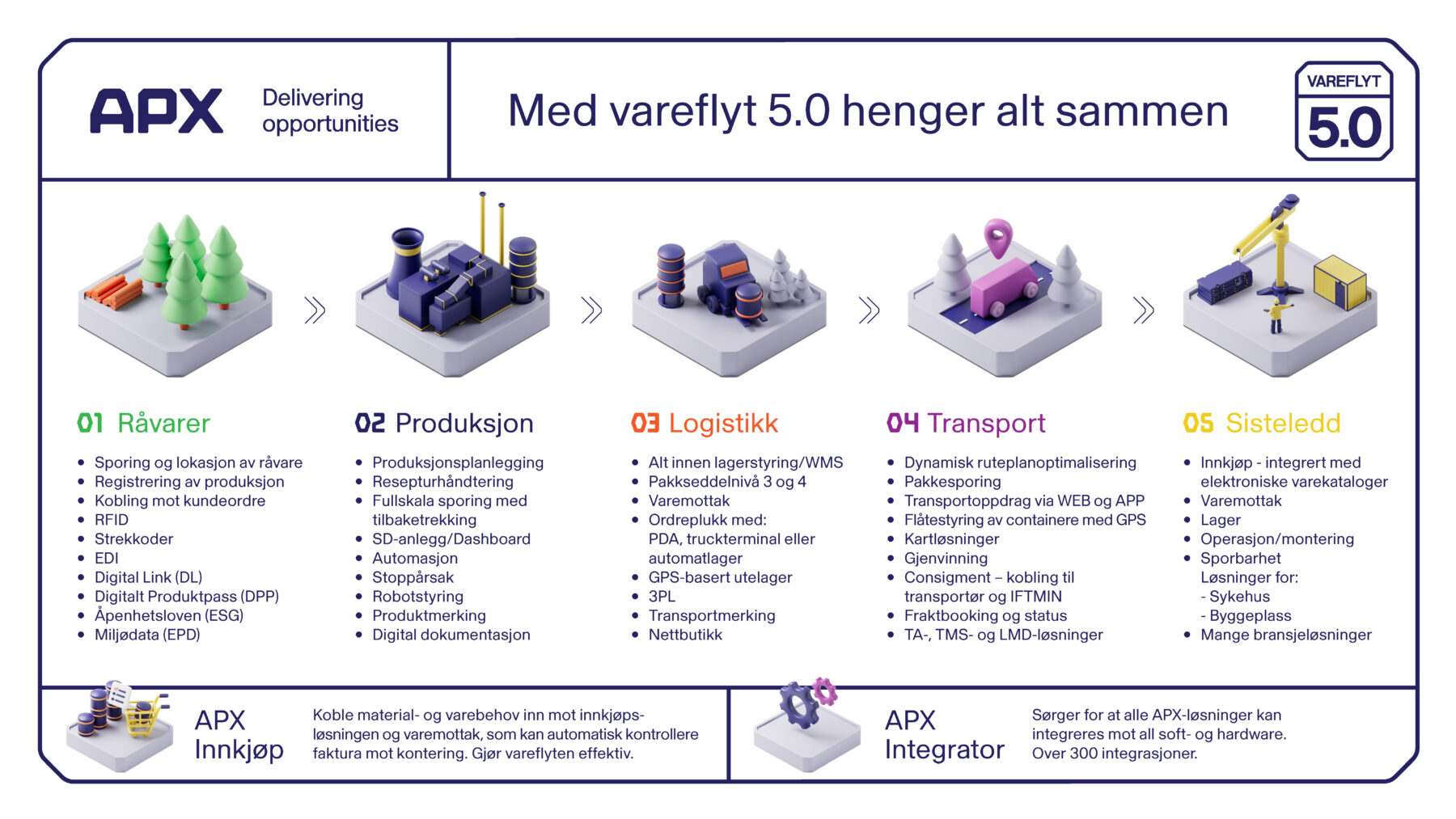
APX VareFlyt 5.0 brings purchasing, production, warehousing, transport and the final stage of delivery into one Norwegian cloud platform. Barcode readers, label printers, RFID equipment and forklift terminals connect directly. Your ERP connects through one integration point. Data follows the goods without re-entry, keeping traceability records available when customers or EU authorities ask for them.
Spend 30 minutes with someone who built the system. Get an outline of which solutions would make the most difference to your business and what they would cost, with no obligation.
Experience since 1992 · 100+ customers and 500 installations · 300+ ready-made integrations · Operated in Norway
When the goods move faster than the information
Here is what happens every week in many businesses that move goods.
- Every time the same order is entered in another system, errors can creep in. And they do.
- The warehouse does not know what production needs tomorrow. Transport does not know what has been picked. Finance is the last to find out. What does that do to your cash flow?
- Every new integration is a separate project, and an upgrade can break it.
- A customer asks for evidence of origin, environmental data or ethical sourcing. The answer takes two weeks and several spreadsheets.
- Five suppliers and five contracts, but no one responsible for the entire operation when something stops.
The underlying problem is that the data sits in separate systems. That can be fixed.
Four things that change when data travels with the goods
Automation in everyday operations
Each invoice line is checked against the agreed price and the quantity received. Transport is booked when picking is complete. Labelling machines, robots and PLCs are controlled from the same system as the warehouse. Staff can spend their time resolving exceptions.
Data that moves between systems
Real-time information at each stage. The warehouse sees production requirements, production sees site progress and finance receives the underlying records. Orders, packing lists and invoices are exchanged electronically through EDI or Peppol between your organisation, suppliers and carriers.
Traceability you can document
Batch and lot numbers, serial numbers and origin data follow goods from raw material to finished product. A scan gives access to EPD environmental data, the digital product passport (DPP), documentation relating to the Norwegian Transparency Act (ESG) and EUDR records. A recall can take minutes instead of days.
Lower project risk
One platform and one supplier responsible for the whole solution. Fewer integrations to build, test and maintain, and upgrades designed to keep connections working. Start with one solution and add more when you are ready.
Unsure where to start?
Use one solution or the entire platform
Seven independent solutions that together manage the full flow of goods.
Purchasing with invoice matching
- From the initial request to the approved invoice. Electronic product catalogues, EDI/PEPPOL, NOBB and EFO. Invoices are checked against agreed prices and the quantities received. Start here if you enter orders and check invoices by hand. Read more
Raw material handling
- Receive, inspect and label raw materials, with batch details and certificates linked to each unit. Start here if you manufacture goods and need to document their origin. Read more
End-to-end traceability
- See the complete history of an item in real time, from raw material to end customer. This provides the data needed for DPP, EPD, ESG and EUDR reporting. Start here if customers or regulators ask for documentation you don't have. Read more
Production
- From basic labelling to full factory control. Manage labelling machines, robots and PLCs in real time. In operation since 1992. Start here if you label goods manually or have machines that can't exchange data with your system. Read more
Warehouse
- From basic receiving and picking to a complete WMS with 600 functions. You only see what you use. In operation since 1999. Start here if staff spend time searching for stock, counting too often or picking the wrong items. Read more
Transport
- Bookings, route planning, last-mile delivery, GPS tracking and secure inbound transport for construction sites and critical infrastructure. Includes a CO₂ report. Start here if you book transport manually and lack updates on delivery status. Read more
The final stage
- At construction sites, hospitals, sterile services departments and schools, staff order goods according to progress and demand, then receive them where they'll be used. Start here if you lose track of goods between the ordering and receiving locations. Read more
More than 30 supporting applications cover label design, checklists, construction site calendars, equipment management, GPS tracking, waste management, automated recalls and more. Use them with the APX solutions, on their own or alongside third-party software. APX Integrator offers over 300 ready-made integrations. All hardware comes from one supplier, and everything is operated in Norway.

What supports our service
One platform manages the entire flow of goods, hosted in Norway, with hardware and ERP connected through a single point. These are the figures and standards behind it.
Questions customers ask before calling
Keep it. APX manages the flow of goods, your ERP manages your finances, and Integrator keeps the two in sync. Existing integrations include SAP, M3, Dynamics 365, Visma, Unit4 and over 300 other systems.
You don't have to. Start with purchasing, warehousing or transport. Each solution works independently, so you can add others when you need them.
The platform scales in both directions, from straightforward stock control for a small business to full factory management for a large manufacturer. You only see the functions you use.
Choose a monthly SaaS subscription or a higher initial fee with lower annual costs. You'll receive a breakdown of the modules and prices before you decide.
We operate the software and hardware in Norway. If something goes wrong, we take responsibility.
The people who built the solution. APX has around 20 employees, several of whom have been here for over 15 years. You'll speak to someone who can answer technical questions directly.

